Last updated, December 30, 2014.
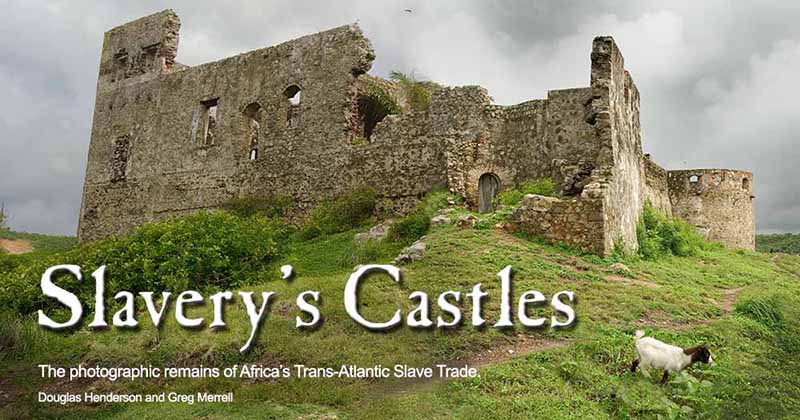
This web site provides information on Douglas Henderson and Greg Merrell's project of photographically documenting the remains of historic sites relating to the trans-Atlantic slave trade in Africa.
These sites include about 30 forts or castles, several slave camps, and at least one slave market spread out over much of West Africa. From the 1600's to the early 1800s, European traders built forts or castles along the coast of Africa to contain slaves until ships could transport the slaves to markets in the New World. Through these grim, utilitarian structures over 12 million people passed on their descent into slavery. While these sites have had enormous impact on the world, they have not been photographically documented to any extent. Henderson and Merrell are attempting to do just that. During the summer of 2010 they photographed about 25 of these sites, with hopes of returning to photograph the remainder in 2015.
Doors
of No Return
23 of the photographs have been assembled into an art exhibit; Doors of
No Return.
This exhibit has been displayed at the Philbrook Musem of Art in Tulsa, Oklahoma, during June and July of 2011. John W. Franklin, Director of International Programs for the Smithsonian Institute spoke at the opening.
In October 18-24,2012
the exhibit was on display at KUONAAFRIKA,
an international pro-Africa conference held in Antwerp, Belgium at the Kineopolis
Event Center.
Doors of No Return was displayed in the Oklahoma State Capitol Building during
June and July of 2013.
Doors of No Return was also been displayed at Tulsa Community College in 2011.
Doors of No Return is available for display for qualified venues and individual prints can be purchased. Please contact Douglas Henderson for more information, 918-688-9606 or by email doug@douglashenderson.com.
Slavery's
Castles; the book.
Henderson and Merrell's photography has been compiled into a coffee table
type book titled Slavery's Castles.
The book conists of about 160 pages of photography accompanied by informational captions and text consisting of brief historical narratives, quotes from slaves and statistical information. Text is historically informative of the slave trade, but not exhaustive, as this is not the focus of this project. The book also includes a satellite photo/map of the Atlantic Ocean, showing trade routes used by slave ships from these castles to their destinations and a satellite photo/map of the coast of Ghana with the castles labeled. As of this writing(Dec, 2014) the book has yet to find a publisher.
About the
Castles.
There are about
28 castles along the coast of Ghana, most of them west of the capital city,Accra.
Then in far west Africa, off the coast of Senegal is Goree Island. Another
stands along the Gambia River in Gambia, also in West Africa. Other sites
are in Sierra Leon, Nigeria, Benin and Togo.
Proximity
Map
Some of the castles are abandoned stone ruins with just a few walls standing, others are still in use as prisons. Several are now "guest houses": for $2. you can spend the night. One, the huge Osu Castle, is the seat of the Ghana's government. At least three are museums, in the African sense of the word museum, which is just a few signs, some artifacts and some small exhibits. Goree Island is sort of a commerical tourist location, complete with restaurants.
When I (D.H.) was photographing AIDS research in Ghana in 2004, I briefly visited three of these castles, but at the time didn't really understand what I was seeing. With very limited time and oportunity, I was able to get just a few snapshots of the castle at Elmina and the one at Cape Coast. I visited several of the dungeons where slaves were kept, passed through the "door of no return", and held in my hands the actual iron bars used to secure the dungeons. These are very strange places. When I returned to the states I wanted to know more about these castles, but was surprised to find almost no information available.
UNESCO, a part of the United Nations, has declared most of these sites as World Heritage Sites of immeasurable historical importance, and steps have been taken to preserve them(read the UNESCO 1998 REPORT)But the countries involved simply have no funds for doing this, and even if they did, HIV/AIDS, Ebola and a thousand other causes would rightly take priority over the historical preservation of these sites. And as such, the sites continue to deteriorate.
The Documentation.
Our
documentaion of these sites consists of high-resolution digital photography
including
The photography is available for purchase to researchers, authors and educators and the general public via this website.
Qualifications: As a professional photographer, Douglas Henderson has over 20 years of experience. His work has been published in The New York Times, Newsweek, Newsweek Japan, The National Enquirer, the National Examiner and others. www.douglashenderson.com
Henderson has considerable experience in Africa and first hand knowledge of the slave trading castles. He has made five trips to Africa, completing photography projects in Ghana, Senegal, Gambia, South Africa, Uganda and the Ivory Coast.
|
DOORS
OF NO RETURN |
|
Phone:
1-918-688-9606
|